
Know Sweat
Is Autism Linked to Hyperhidrosis?

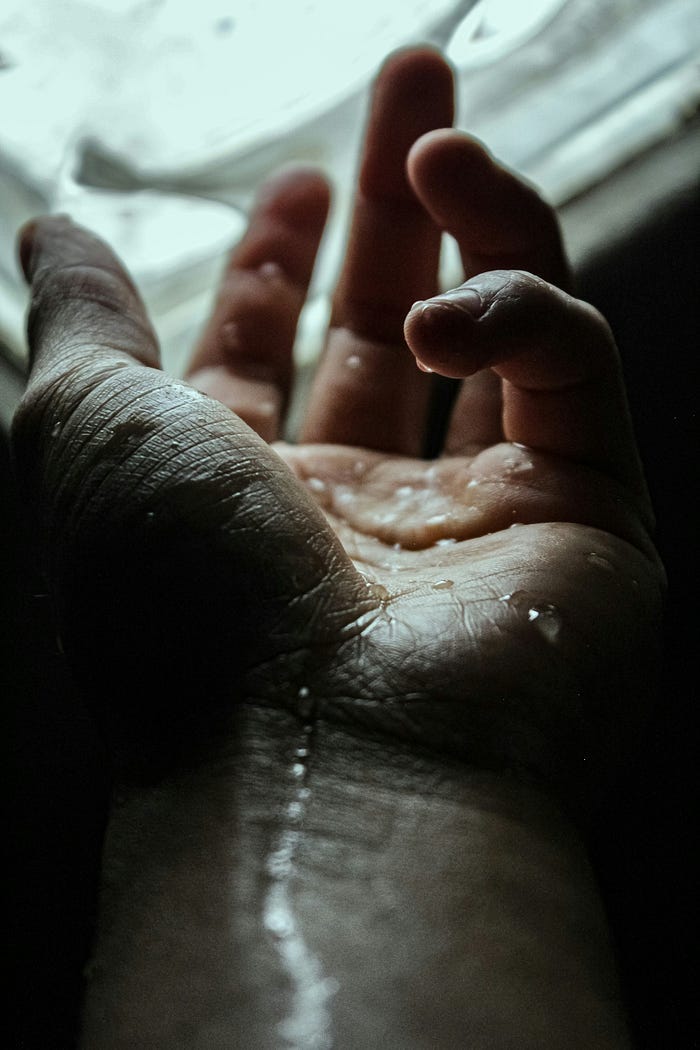
Imagine being drenched in sweat. Not just your body, but your hands, feet, and face are dripping sweat. And it’s not because you’re hot, or because you physically exerted yourself, or because you’re sick or even nervous. It’s just your normal state of being. You can take showers, you can carry a towel to dry yourself with, you can stand in front of a fan, but none of it makes a difference. You’re doomed to be drenched in sweat most of the time, even when you’re asleep. Do you think that would alter your quality of life?
This situation isn’t just a hypothetical for 5% of the global population. It’s a lifelong nightmare called hyperhidrosis (Hh), and I, like roughly 17 million Americans, was born with it.
November was Hyperhidrosis Awareness month, and my guess is that a lot of people reading this article have never heard of it — and that a lot of people reading this article struggle silently with the disorder. It’s not exactly an invisible illness, but the difficulty and shame that comes with it make people who suffer from Hh eager to hide from the world in an attempt to make themselves invisible.
Within a day of my birth, my mother noticed I was sweating constantly. My pediatrician had no answers for her, and in rural Texas in the 1970s, there weren’t a lot of informational resources to tap. For the first decade of my life, we just knew I — and particularly my hands, feet, face, and armpits — was sweaty most of the time. I was a pariah at school where children are often made to hold hands and touch one another.
“She’s juicy! Please don’t make me touch her!” was something I got used to hearing children wail to the teacher as they shrank away from me. It didn’t take long to get the message. Not only was my sweat physically uncomfortable, it was socially debilitating. From my earliest awareness, I was told by my peers that I was gross. It’s impossible to disentangle the impact of that message from my lifelong struggle with depression and anxiety, and I’m not alone in that.
A 2025 review published in the Journal of Cosmetic Dermatology found that “Most pediatric and adolescent patients with primary hyperhidrosis reported severe impacts on quality of life and emotional well-being. Reported symptoms included poor interpersonal functioning, isolation and loneliness, issues with work or school-related tasks, perceived stigma and high social visibility. Children with hyperhidrosis were also found to have high rates of depression (40.9%) and anxiety (31.8%).”

Photo by Caleb Woods on Unsplash
That was absolutely my experience. Depression and crippling anxiety have steered the course of my life. By the time I was 8, I was fantasizing about dying the way other little girls were fantasizing about being a Dallas Cowboy cheerleader.
Besides being mocked and shunned by my peers, school work was greatly complicated by my condition. Any sheet of paper I wrote on was soaked within a minute, with the writing smeared across the page, and my textbooks generally had to be retired after my use waterlogged them. My sweat has made my life a constant struggle.
When I was 10, my mother and I saw a segment on a TV show called That’s Incredible about a young man who also had my sweating affliction. Suddenly we had a name for it — hyperhidrosis. The “cure” he underwent was a thoracic sympathectomy, a surgery in which some nerves of the sympathetic nervous system deep in the chest are severed. That surgery became my dream, but it wasn’t covered by insurance. So we tried everything else we could; pills, ointments, iontophoresis machines that delivered electric shocks to my skin, acupuncture, Botox shots, literally everything on the market. Nothing worked. I grew up mortified by my condition, and hopelessly depressed.
Eventually, as an adult, I had the surgery I’d longed for since I was a child. In fact, I had it twice. The first one didn’t work, and the surgeon thought a second one would take. It didn’t. Tens of thousands of dollars went down the drain with no impact on my condition. And so my sweaty life went on.
I wish this was one of those stories with a happy ending. My story’s not finished, but as I sit here typing, all alone in my cool, comfortable home, sweat drips off my fingertips onto the keyboard. I have a towel in my lap that I use every minute or so to wipe the sweat from my face and to blot the sweat from my hands. This is the reality of my life. And while I haven’t found a cure, or even a way to curb my constant sweating, I think I may have stumbled onto something that may eventually help other people, even if it never helps me.
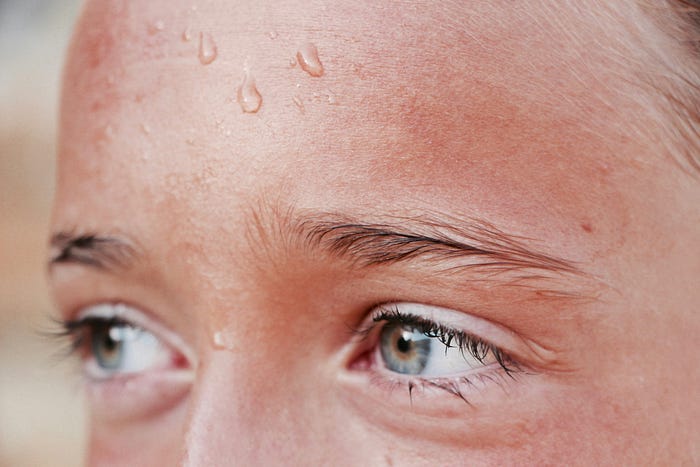
Three years ago, when I was 49, I was diagnosed with autism. At the time, I didn’t know anything about ASD (Autism Spectrum Disorder). I certainly didn’t have any idea that it could be connected at all to my hyperhidrosis. But the more research I did into both, the more I started to wonder…are the two disorders that have so altered the quality and trajectory of my life somehow linked?
I’ve learned in the last three years that both autism and hyperhidrosis are disorders of the central nervous system, and while science doesn’t seem to have discovered a definitive link between the two, they commonly occur together.
There isn’t a lot in the medical literature that I’ve found, but a 2022 article in Frontiers in Psychiatry mentions “Increased sweating has been observed in children with ASD, and one is likely to notice a greater presence of sweaty skin especially on the extremities (hands and feet).” I don’t claim to be an expert medical researcher, but I’ve not found a lot more than that.
However, there’s ample anecdotal evidence that there is, if not a causal relationship between the two conditions, at least a correlational one.
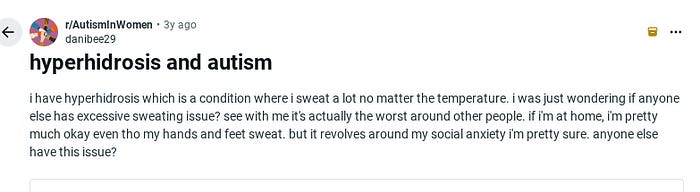
A Google search for hyperhidrosis and autism yielded this thread from the Autism in Women Reddit page, with dozens of commenters weighing in about their own experiences.
And there’s Paige Layle’s memoir “But Everyone Feels This Way: How an Autism Diagnosis Saved My Life,” which opens with the author’s diagnosis scene, in which she’s sweating profusely.
“I hate the feeling of sweat on my skin,” the book begins. And a page later: “My sweating situation was not due to the mid-August heat. The room was air-conditioned and chilled, and I’d been without physical activity for hours, waiting, talking.” She goes on to write that her “brain makes her body sweat, no matter the climate.”
Sounds like hyperhidrosis to me.
I’m not a doctor, and I won’t pretend to understand how they’re linked, but my gut tells me — and observation backs me up — that there’s a profound relationship between autism and hyperhidrosis, and it goes way beyond the fact that neither one is well understood, and that both are under-diagnosed.
What I know for sure is that I was born with both, and that it’s nearly impossible to extricate one from the other in reflecting on the impact they’ve had on all aspects of my life.
The social difficulties experienced by autistic people are one of the salient features of the disorder, and they’ve been compounded for me because I’m usually dripping sweat. If I’m not already nervous and awkward in a social setting, the fact that I’m sweating will signal to those around me — and even moreso to my own brain — that I’m anxious, setting off a feedback loop of misery. And all of that complicates the already bleak statistic that up to 85% of college-educated autistic adults are unemployed. Job interviews while dripping sweat are nightmarish scenarios, and if I do manage to get hired, office scuttlebutt about the sweaty new hire makes work uncomfortable from day one. Maybe if people understood the things I’m writing about here, they’d be a little kinder. I like to think so.
Being autistic is not always easy, but for me hyperhidrosis is magnitudes worse. At least now I know I’m not the only one who struggles with this particular combination.
It’s my hope that one day medicine might figure out the link between these two major disorders that have dominated my life and the lives of so many others, but that might not happen in my lifetime. So for now, I suppose I’ll have to settle for raising awareness about both.